Spot and futures: what's the difference
Short version for experts: tables, lists and screenshots only.
Words in this lesson (10)
Spot
Spot is an ordinary purchase. Buy a coin — it's yours, it sits in your account. You can hold it for a year or transfer it to another exchange.
- You can only make money when the price rises.
- No leverage.
- You can lose everything only if the coin falls to zero.
Futures
Futures are not a coin but a contract on its price. You don't own the coin — you gain or lose the price difference.
- You can make money both on a rise (long) and on a fall (short).
- There is leverage.
- There is liquidation.
In crypto, people mostly trade perpetual futures — they have no expiry date and can be held as long as you like.
| Spot | Perpetual futures | |
|---|---|---|
| You own the coin | yes | no |
| Profit on a fall | no | yes |
| Leverage | no | yes |
| Liquidation | no | yes |
| Holding cost | no | funding |
Funding
Since a perpetual futures contract has no expiry date, there has to be a way to keep its price close to the price of the actual coin. That way is funding: every few hours some participants pay others.
- The futures price is above spot (everyone wants to go long) → those who are long pay those who are short.
- The futures price is below spot → the other way around.
The amounts are usually small — hundredths of a percent. But if you hold a position for weeks, they add up.
What a beginner should choose
Start with spot, or with futures without leverage. That way you learn to read the market instead of fighting liquidation.
Where this is in MAMAY
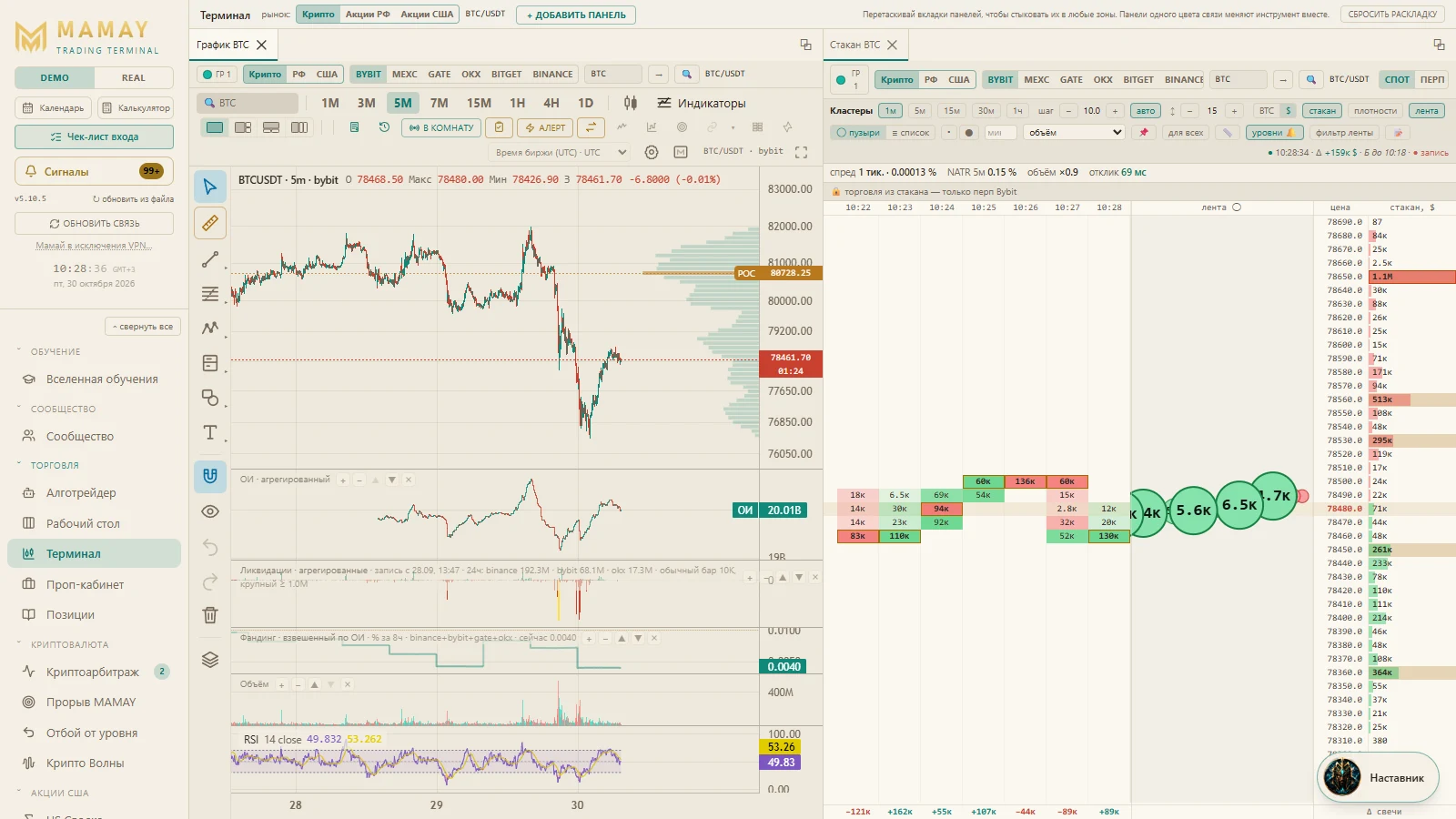
- The "Terminal" tab trades futures.
- In "Crypto Arbitrage" opportunities come in three kinds: spot versus futures, futures versus futures, and earning on funding. That's arbitrage — a separate learning track.
▶ Next: what to expect from trading