
Trading psychology: how not to blow your account on emotions
Accounts are often lost not because of a strategy but after a losing streak, when you want it all back at once. Here's how to notice this from facts rather than feelings.
What happens to a trader
A loss feels like pain you want to stop immediately. That's the source of the most expensive decisions: entering again, bigger than usual and without a plan.
| Trap | How it shows up | How it ends |
|---|---|---|
| Revenge trading | Entering right after a loss | A string of losses within an hour |
| Growing size | A larger position after a loss | One day takes weeks of gains |
| Fear of missing out | Entering a move that's already happened | Buying the very top |
| Moving the stop | "I'll wait a little longer" | A small loss becomes a big one |
| Overconfidence | Risk grows after a winning streak | One trade takes the profit |
Why "just be calmer" doesn't work
In the moment of emotion you judge your own state poorly: it feels like you're in control. So rules have to be set in advance, while you're calm, and based on facts: how many losses in a row, how much is down today, how much your size has grown.
Rules that help
- A daily loss limit. Hit it and you're done for today.
- A break after a streak. For example, an hour with no trades after three losses in a row.
- A mandatory stop on every order.
- Position size calculated in advance. See the article on risk management.
- An entry checklist. Two or three questions sober you up better than willpower.
- A journal with the reason for entry. Later you'll see how many trades followed the plan and how many came from emotion.
The numbers here are examples. What matters is that they're set before trading, not during a drawdown.
How MAMAY tracks this
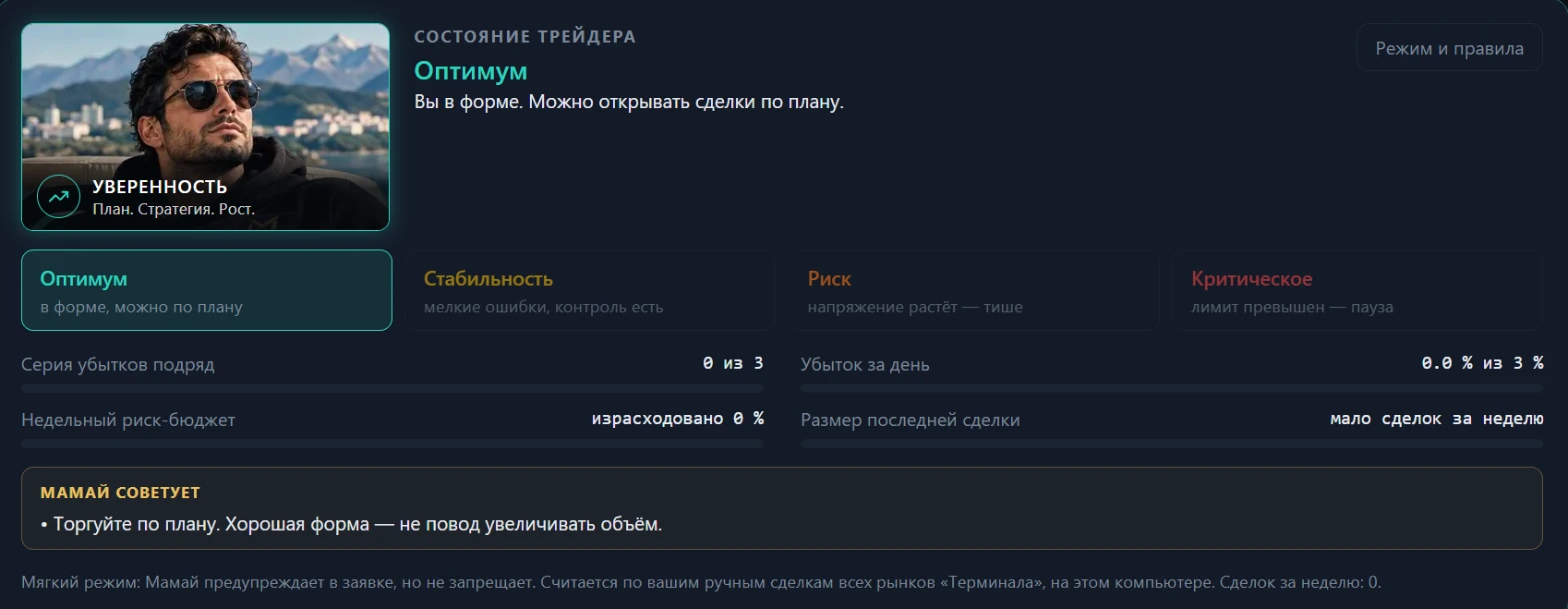
MAMAY calculates your form from manual trades across all markets: losing streak, daily loss, weekly risk budget and trade size against your usual. There are four levels, from "Optimal" to "Critical".
- Soft mode. A warning on the entry order.
- Hard mode. In "Critical", new entries are blocked for the chosen time or until the next session, and in "Risk" an entry bigger than usual won't go through.
- You can always close or reduce positions.
You set the thresholds, everything is calculated on your computer, and your personal diary goes nowhere. The trade review also finds repeating mistakes in your history: entering right after a loss, trades without a stop, size growing after a losing trade.
FAQ
What is tilt in trading?
A state where decisions are driven by emotion, most often after losses. Signs: entering right after a loss, growing size, abandoning the stop.
How do I stop revenge trading?
Set a daily limit and a break after a losing streak in advance. It's most reliable when more than willpower enforces them: for example, when the terminal blocks new entries.
Does DEMO help with psychology?
Partly. On a DEMO account you can practice the rules, but emotions are weaker there. So start with minimum size on a real account.